PTT Pul Müzesi: Turkey’s History on Small Rectangles of Paper
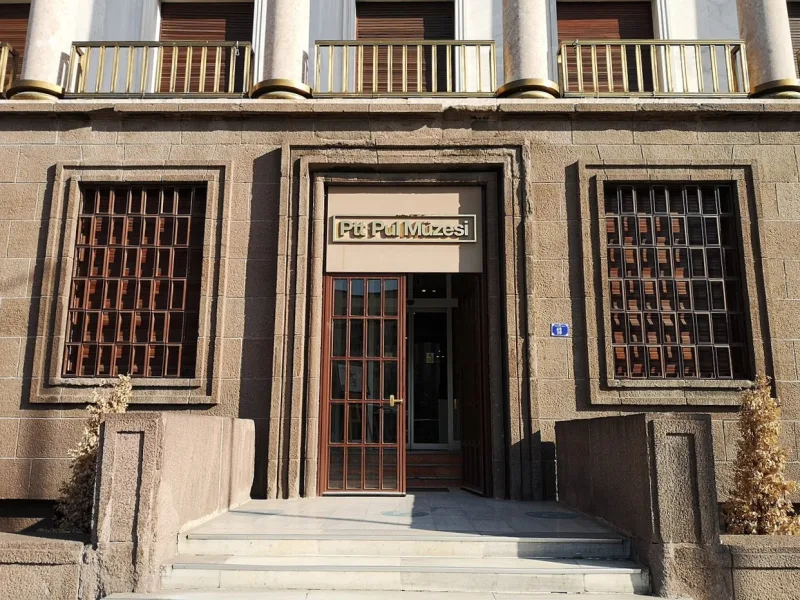
In the Ulus district of Ankara, on the city’s main thoroughfare—Atatürk Boulevard—stands a stark modernist building designed by the renowned Austrian architect Clemens Holzmeister. Today, it houses the PTT Stamp Museum, Turkey’s only national museum of postage stamps. Spanning five floors with a total area of 6,500 square meters, the museum houses stamps from the Ottoman Empire, the Republic of Turkey, and many countries around the world—a miniature yet comprehensive portrait of the last two centuries of world history, told through philately.
History of the Museum
The museum opened in 2013 and became the first of its kind in Turkey. The building that houses it is an architectural landmark in its own right. It was built in 1933–1934 based on a design by Clemens Holzmeister, an Austrian architect who left behind a series of iconic buildings in early Republican Ankara. Originally, the building served as the headquarters of Emlak ve Eytam Bankası; after the bank’s merger in 1946, the building was transferred to the Turkish Postal Service (PTT), and following restoration, it became a museum.
The transformation of the former bank into a stamp museum is a typical example of the adaptive reuse of historic architecture in Ankara. The spacious bank halls with high ceilings were ideal for displaying miniature exhibits that require good lighting and thoughtful arrangement.
The Collection and What to See
Ottoman stamps
The Ottoman section of the collection is one of the most valuable. It features the first issues of the Ottoman Empire, beginning in 1863, as well as series from the late 19th and early 20th centuries featuring Arabic script, portraits of sultans, and views of Istanbul. Today, these stamps are coveted items for collectors and, at the same time, valuable historical documents that capture the fashion, ideology, and graphic style of a dying empire.
Republican Section
A separate section is dedicated to stamps of the Republic of Turkey, beginning with the first issues of the 1920s. Here, one can see how state symbols, typefaces, and artistic styles evolved—from the minimalist graphics of the early republic to the multicolored thematic series of the late 20th century. Stamps featuring portraits of Mustafa Kemal Atatürk, issued for anniversary dates, hold a special place.
Thematic displays
The exhibition is organized by theme: cultural heritage, transportation, sports, nature, and tourism. This approach allows visitors to trace how the Turkish state presented itself to the world through philately—which monuments, events, and natural landscapes it deemed worthy of miniature publication.
International Collection
The third major section features stamps from other countries around the world. Here you can see classic issues from the United Kingdom, the United States, the Soviet Union, and European countries, as well as rare stamps from colonial powers. This section is particularly valuable for understanding how Turkish philately fits into the global context.
Building Architecture
Don’t miss the elements of the original bank interior: staircases, safe doors, and remnants of the trading floor’s decor. They offer a glimpse into the scale of business life in Ankara during the 1930s and the signature style of Clemens Holzmeister, whose buildings shaped the appearance of the young republic’s administrative center.
Interesting Facts
- The museum building is the work of the same architect, Clemens Holzmeister, who designed the Turkish Grand National Assembly, the Ministry of Defense, and many other key structures in the republic’s capital.
- The first Ottoman postage stamp was issued in 1863, making the Ottoman Empire one of the earliest participants in the international postal system.
- The Turkish postal service, PTT, dates back to 1840, making it one of the country’s oldest operating state institutions.
- The museum is located just a few minutes’ walk from Ulus Square and the Türkiye İş Bankası Museum of Economic Independence—both sites are convenient to visit together.
- With 6,500 square meters of exhibition space, the PTT Pul Müzesi is one of the largest philatelic museums in the region.
How to Get There
The museum is located at Atatürk Bulvarı No. 13, in the Ulus district of Ankara—in the heart of the old republican capital. The nearest metro station is Ulus (Ankaray line), a few minutes’ walk away. From Kızılay, it’s a convenient 10–15-minute ride by metro or minibus.
GPS coordinates: 39.9383° N, 32.8542° E. From Esenboğa Airport (ESB), take the HAVAŞ bus to Ulus, then walk. If you plan to combine visits, the İşbank Museum, Hacı Bayram Mosque, and Julian’s Column are all within a 500-meter radius.
Tips for travelers
Allow 1.5–2 hours for your visit: the collection is large, and examining the stamps requires patience and good lighting. It’s best to come in the afternoon, when the main crowd of local school groups has already dispersed.
It’s convenient to combine your visit with a walk through Ulus and a stop at the İşbank Museum of Economic Independence—both are just a few minutes’ walk away. If you have time, head up to Ankara Kalesi and visit the Museum of Anatolian Civilizations.
Photography is usually permitted without a flash. It’s best to check prices and schedules in advance: opening hours depend on the PTT’s current program. For collectors and fans of 19th- and 20th-century graphic design, the PTT Pul Müzesi will be one of Ankara’s most unexpected and delightful discoveries.